
Share Mary Sue Mcdonald's obituary with others.
Invite friends and family to read the obituary and add memories.
Stay updated
We'll notify you when service details or new memories are added.
You're now following this obituary
We'll email you when there are updates.
Select your format and elements to print

IN LOVING MEMORY OF Mary Sue Mcdonald
Mary Sue
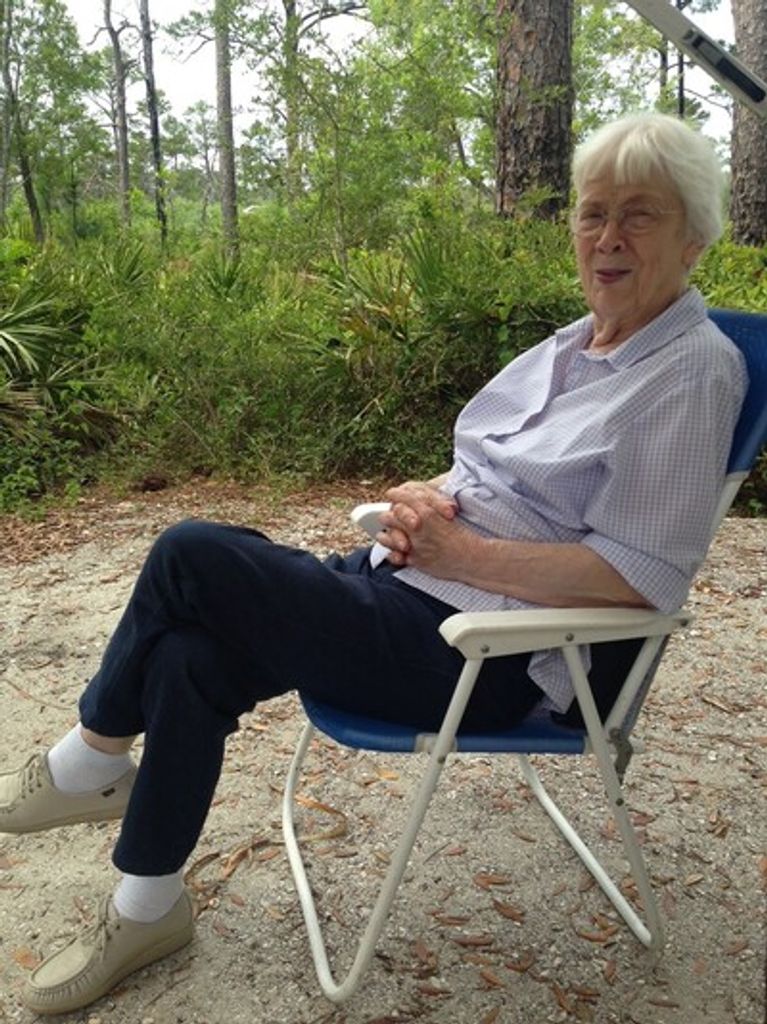
Mcdonald
Jul 9, 1932 — Jun 16, 2021
Pensacola
Mary Sue Mcdonald's Obituary
Like so many people of her time, Mary Sue Hall (McDonald) was born in a house on Glass Street in Chattanooga on July 9, 1932. Her roots, no matter where life took her, always remained anchored to Tennessee.
Her mom (Leila, nee Roberts) and dad (Bart) raised her in rural Eastdale on the east side of Missionary Ridge, long before there was an I-24 and 500,000 moving cars per day. Mary Sue's memories were of chickens, walking to stores and other's homes, getting black soot around her nostrils from the air pollution caused by coal burning, and riding a bus through the McCallie Tunnels through the ridge to Broad Street to go shopping in downtown Chattanooga. She had fond memories of playing on a porch at a family house up on Signal Mountain, smoking "rabbit tobacco" with her friend Nancy McA., and playing with her older sister, Kathy and Toby the cat. She supported the war effort by recycling steel cans (take both ends off, and smash the lids between the can) and listening to FDR and his fireside chats on Papa Roberts' radio. She loved it when her baby brother (Jack) was born in the late 1940's. Mary Sue learned a bit of piano, although her singing never quite got you there. Her diet consisted of pinto beans, Tennessee iron pan sausage gravy and biscuits, endless coarse meal buttered cornbread, snap beans, lean ham, and an occasional pineapple/banana and mayonnaise sandwich or two for lunch. She was a serious chocoholic. Her not-so-fond childhood memories included being at a Catholic school and having a nun slap her on the wrist with a ruler, then pulling her by the ear to stop her from talking and playing around during class.
Important skills were learned as a child, including sewing, from her mother and aunts. Those sewing skills, in addition to her favorite class in high school (home economics) lit a fire of artistry that became a way of expressing her Appalachian culture throughout her life.
She disdained being uprooted. But the times were changing. Her parents moved to Grandview, Tennessee for two years during the Great Depression to live solely off the land. Bart was able to gain employment working at a foundry in Chattanooga. The pounding, noise, and heat made him dream of a better life he had heard about in a far away and very different land... Miami, Florida. He moved there and easily found a good living. He wanted his family to move there, too.
With reluctance, Mary Sue moved to Miami. Already an international and rapidly growing tropical city, it was unfamiliar. She missed her Purple Pounder classmates of Central High School in Chattanooga, and moved back home to live with her Aunt Katherine for her senior year. While with her Aunt Katherine in the early 1950's, quilting first entered her life. She eventually returned to Miami, but again returned to Chattanooga once more before returning to Miami for almost 30 years.
She had her first son, Steven, in the mid-1950's by her first husband, Howard. She became a single mom some years later. Life got tough in her 20's. Through it all, her parents gave her support. Already being a PBX operator, later promoting to drafting clerk at Southern Bell, Ma Bell helped her to make ends meet.
By 1961, a new man came along, John McDonald, who would become her yankee husband until his passing. She, along with Jack and Steve, moved to a new development called "Leisure City" in South (Miami-)Dade County. There were no air conditioners then. The no- see-um insects were so tiny that the bugs would go right through the screens of the house and bite all night and day.
South Dade County was about as close as one could get to the epicenter of the 1961 Cuban Missile Crisis. She once said of those days, "We all thought we were just going to get burned up." Fortunately for everyone, things turned out far better than that.
By then, the family moved to Florida City into to a small home just north of Palm Drive. Her second son, Lawrence, was born in the early 1960's. She left her Southern Bell job, thinking of going back one day, but she never did. In that house Mary Sue remembered with sadness about watching a TV soap opera on a late November afternoon when a special report appeared announcing that JFK had been shot. She never forgot that moment.
Her young new family pressed forward, surviving John's drunkeness and arguments, along with one harrowing night as Hurricane Betsy roared through, blowing water under the back door and through roof shingles. She took it with worried heart, and huddled with her boys in the hallway. Those days were also quite tight, financially speaking. "We only had one or two nickels left just before the next paycheck came in," she once said.
Still, she found it in her to look forward. She read about a larger house for sale just a few blocks away, advertised in the classified ads in something known as a newspaper. And she pushed to have the house purchased... for the outlandish high price of $13,000! With its 100' by 150' lot, the house was a paradise compared to smaller homes that had come before. A yard, other kids in the neighborhood, and the dreaded nearby vacant pine covered lots and "the slough" where tree houses were built of scrap wood by Steve, and where her boys captured snakes, turtles, frogs, birds, and scorpions, bringing them inside for show and tell... or at least so they thought.
"Get that thing out of this house!"
Somehow and someway, Jesus must have visited one night. In 1967, she took her two boys to a small Methodist church, got 'em baptized (ooooh, that cool water running down her kid's necks on a hot South Florida Sunday morning). Then she had "the Preacher" visit repeatedly and inconveniently right at the time John would start drinkin'. Somehow and someway, he stopped drinking. That started a decade of really, really going to church... a lot... a whole lot... not just every Sunday, but every time the doors opened.
Mary Sue plunged herself deep into church life. She taught Sunday School, led Vacation Bible School in the summer, and became the Sunday School superintendent (with body shaking from stage fright when she had to make announcements). There were Christmas plays, Easter Pageants, the Fall Festival, snowbird-filled pews in the winter, and nearly empty pews in the summer. Then along came dubbed music on cassette tapes by Bill Gaither and sing-alongs at the Florida City Camper Park. And those beloved summer trips to North Carolina at Lake Junaluska Methodist Assembly, the cool relief from the summer heat... and a hint, a reminder of her Southern Appalachian roots.
During those summer trips to North Carolina, she experienced nearly nonstop exhibitions and festivals celebrating the upcoming U.S. Bicentennial in 1976. Many old themes were resurrected at that time from those happy days of Mary Sue's childhood. The past necessity of quilting previously learned was now called "folk art". From that point forward, quilting became an obsession (nearly to the point of being possessed) in her life until her fingers and eyes became too old and feeble to sew another stitch.
By the end of the 1970's, some surprising health problems emerged for someone so young. It started with some heart issues, and then the diagnosis of a troubled thyroid. Little did she know that both would cast a shadow over her up to the last days of her life.
An old nemesis returned, too... talk of uprooting. If there was one thing Mary Sue despised, it was moving away, or having people moving away from her.
It was a perfect storm. An older husband, stressed out by work and with his own set of health issues wanting to retire to "someplace else". Then there was the rapidly declining neighborhood, now riddled with crime. Finances had improved somewhat. But "the move" became a frequent topic of debate and discussion.
They looked for places to move. Land in North Carolina and in Tennessee was bought, then sold. New local subdivisions were considered. Yet no place seemed to appease her. For Mary Sue, it all came down to trying to justify why the house that she had found years before in the newspaper ad, as well as the place where her boys were raised, had to be let go. Realistic thinking about a future lived in a retirement setting was set aside, and raw emotion took over. The changes needed could have been accomplished even in a simple local move, but she could not see why or how any move was necessary. Then, one afternoon after the reluctant stroke of a pen, she was moving to a site unseen somewhere in the Florida panhandle... about as opposite from South Florida's culture and conveniences as one could get, and far too far from her family unit.
Complete and utter emotional devastation followed. Months of tears, months of depression. The winter of 1983-84 was cold, long, and hard for Mary Sue in so, so many ways.
With time, as Mary Sue met a number of women who became close friends, she began to heal. Bagdad United Methodist Church and the quilting circle there re-stoked quilting fever. For the next twenty years cloth took over the house. Whole bedrooms were dedicated to the storage and quilting of cloth. Cloth shops were scoped out. Cloth shops were visited. Cloth was sought at yard sales. In her travels, her eyes were on the lookout for quilt and cloth shops. The ultimate find was Keepsake Quilting in Center Harbor, New Hampshire. To Mary Sue, her place in heaven today must emulate the appearance, along with the joy and creativity she experienced while walking among bolts of cloth and pattern kits at Keepsake.
Another move happened in 1993, this time from Milton to Pensacola. It was a good relocation event for Mary Sue and John. They were closer to doctors, there was much to do that was new, it was more urban, and a little closer to what life was like back in Miami. Her sons would visit, and her family would be back together, even if for just a few days. The menu was always ham (but sometimes seafood) with mashed potatoes, green beans, and chocolate yum yum cake for dessert. It was nearly a rite of passage to sit and eat the meal with her.
She bravely dug into the new internet world of Prodigy and the online quilting rooms. Patterns were shared, and resources (cloth) exchanged with new friends from around the country. She took well to the early transition into the information age even up to her final years.
Then, something began to manifest as a subtle, then as an accelerating revelation. It was a simple fact: Time progresses during life. Time passage is nearly imperceptible in those first fifty or sixty or maybe even seventy years. Years simply go by, becoming remembered more like days. An unrecognizable object appears as a thin line across the horizon, across a plain that once seemed like something boundless or endless. Looking back you see a youthful life, always with a view of the good times and the bad, the good choices and the mistakes. New faces joined along the in the journey. Some older loved ones and acquaintances left the journey, and some passed on, yet they were always beloved and cherished. But ahead now was something different. The object grows larger with time, and eventually became obvious as to its identity... the finale of one's own life.
The horizon first appeared to Mary Sue well in advance of John's passing in 2008. Maybe it presented itself too soon. With twelve years of age difference, Mary Sue got a glimpse of the horizon. She did not like it. Although she tried to get around it, and hide from it, and made attempts to recreate life as it was so long ago, it kept appearing larger with each passing year. The harder she tried to avoid acknowledging its presence, the greater a struggle each day became. Those numbered days that could have become good days, good years, were too often spoiled by wishing instead for some moment-gone-by, a whisp of a what was a fantasy of the past.
Unfortunately for Mary Sue, a real and present danger entered the picture. Her problematic thyroid and heart problems, although they appeared "cured" by medicine, were still tucked away in her chest. And for a new danger that appeared, there was no pill, and no cure. Alzheimer's Disease simply does not work that way. It can be slowed, perhaps, just only briefly. Once on the horizon, it cannot simply disappear. A not so distant view brought about sadness and confusion as the disease began to show itself as it inched closer, day by precious day.
Coupled with two unexpected major surgical events over an eleven month span and the anesthesia administered, her ability to sew, to stitch, to create, to enjoy, to relish... to simply be engaged in life... was taken by a cruel, heartless disease. The once distant horizon seen years before turned out to be a coastline along simple sandy beach. She arrived at that point, the finale, on June 16, 2021 at the age of 88. A peaceful, calm landing with no more strength left to paddle and explore something new, or to even say "Hello" and share in another meal. The horizon was discovered to be a place to pass quietly into eternity.
Through and through, Mary Sue Hall-McDonald was a Tennessee girl, a prodigy of Appalachia's European settlers. She leaves behind two sons: Steven of Dade City, Florida (his wife Trina, grand children Becky, Ryan, and Kyle, along with six and soon to be seven great grandchildren); Lawrence of Pensacola, Florida (his wife Twinette, granddaughter Michelle, and two great grandchildren); and her dear brother, Jack Hall, of Bridgton, Maine (her nephew Brendan and a great nephew). Preceding her in death was her sister Kathy, first husband Howard, and second husband John, and most importantly her parents Bart and Leila, whom she utterly adored.
Mary Sue will be interred at the City of Tavares Cemetery in Lake County, Florida in a private ceremony with family. She will be laid to rest alongside the graves of her parents who will care for her in her new quilting room. Mary Sue will also be returned to the land of her birth in Tennessee near old Jalapa (Monroe County), now Tellico Plains, one of several settlement locations of the Shahan's, recognizing her mother's ancestral pathways from Townsend, Chilhowee, and Cades Cove to Chattanooga in the 1700's and 1800's. Also in Tennessee, she will be placed in Piney Flats (Sullivan County), ancestral home of her father and not far from the Hall family farm somewhere under Boone Lake, tracing back to 1622 from Jamestown, Virginia, as well as to Maryland. Lastly, Mary Sue will be placed in Gulf Islands National Seashore because of the joy she had watching the waves of the Gulf of Mexico come ashore in the evening light, as well as being in near proximity to the gravesites of John, and of Kathy, at Barrancas National Cemetery across Pensacola Bay.
Thanks is given to everyone who provided care and friendship through the years. This includes staff and residents at Wesley Haven Villa in Pensacola (yes, you Vera and Erin, Helen, Janice, and Rita among them); a myriad of caregivers from Covenant Hospice; to Cleo C. of Macon, Georgia who breathed a spirit back into her life in her final years; to Dr. David Miles; to Lavon S. and Anita S. back in South and Central Florida; and to those at Bagdad United Methodist Church for being her friends and keeping in touch over the years.
Flowers and donations are not necessary. We instead respectfully request that you take time to plant flowers in your own yards and share the beauty with your loved ones and friends while remembering the life of our mother, quilter, and cloth pack rat, Mary Sue Hall-McDonald.
You're now with Jesus, as you mentioned so often. Rest in peace, Mom. We love you. And, next time you start sewing, wear your thimble.
Funeral Services for Mary Sue Mcdonald
Private Family Services
Mary Sue Mcdonald's Guestbook
Visits: 22
This site is protected by reCAPTCHA and the
Google Privacy Policy and Terms of Service apply.
Service map data © OpenStreetMap contributors